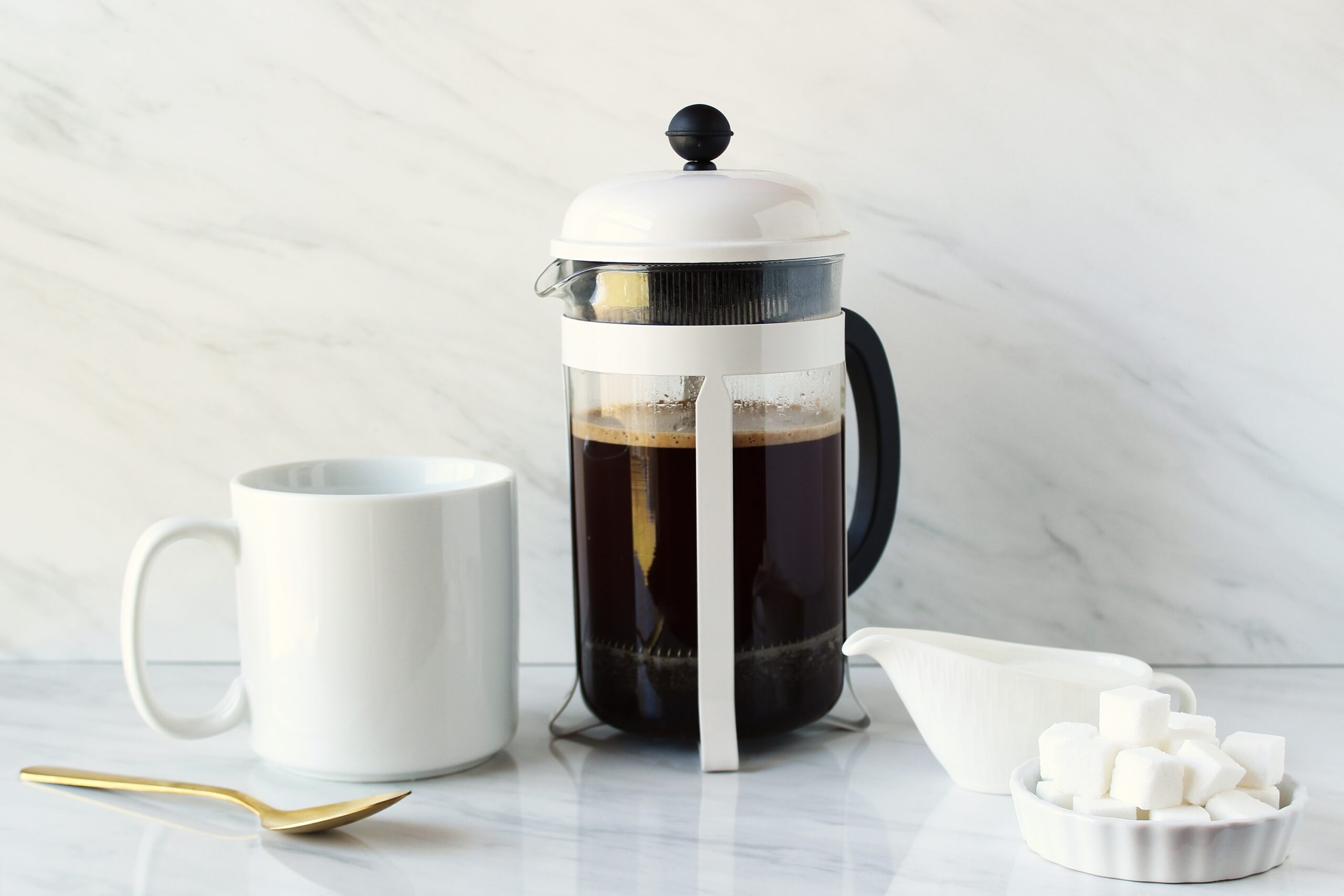
If you’re a French press coffee fanatic like me, then you not only make French press coffee just about every morning but also need to know the science behind this brewing method and how it works. In this article, I’m going to be taking a deep dive into how French press coffee works and probably provide more information than you could possibly want. Ready to nerd out with me? Let’s get started.
How Does a French Press Work?
The mechanics of the French press couldn’t be much simpler. French press coffee is an immersion style of brewing that doesn’t use a paper filter, so there are only a few parts to the entire system.
- Brewing Chamber or Carafe: This is, unsurprisingly, where the brewing takes place. In a glass French press, this is the glass component that houses the hot water and coffee grounds. In a stainless steel or stoneware French press, the brewing chamber usually includes the entire French press body, including the handle.
- Lid With Plunger: The lid of your French press serves to maintain a good brewing temperature when you’re brewing your coffee, and it also holds the plunger in place for the actual pressing of your coffee.
- Plunger Base or Cross Plate: The plunger base is the piece that has a cross on it and screws onto your plunger. Above the plunger base, you put the mesh screens and then the spiral plate.
- Mesh Screen(s): The mesh screens get sandwiched between your cross plate and the spiral plate. The screens are what filter most of the grounds out of your coffee when you press down on the plunger. The finer the mesh, the more of the finer coffee bean particles you’ll remove from your coffee — more on why this is important later.
- Spiral Plate: The spiral plate has a spiraled edge that serves to make sure the flimsy mesh screens get pushed up against the side walls of your brewing chamber when you press down on the plunger. This helps prevent grounds from leaking up above the mesh screens and getting into your cup.
- Carafe Holster (Optional): Glass French presses usually have a plastic or metal holster for the carafe. It houses the glass piece to provide a handle. The glass is removable for easy cleaning.
So, how do all of these components work together to make French press coffee? Well, you put grounds in your brewing chamber, add hot water, stir, and put the lid on without pushing down on the plunger. Once the coffee is done brewing, you push the plunger down. At the end of the plunger, the cross plate and spiral plate hold the mesh filters in place to push most of the grounds down to the bottom of the brewing chamber. Then you pour coffee off the top.
It’s simple in theory, but again, the science behind getting this brewing method right can get complicated. Queue the nerd-out!
The Actual Science Behind How French Press Coffee Makers Work
“Brewing” coffee means exposing coffee grounds to hot water for a designated amount of time. A chemical reaction occurs when you brew coffee, which results in a bunch of compounds getting pulled out of the grounds and into your water. These include:
- Linoleic acids
- Palmitic acids
- Oleic acids
- Simple carbohydrates (sugars)
- Caffeine
- Triglycerides
- Diterpene alcohols
- Sterols
- Tocopherols
- Phosphatides
- Melanoidins
- Fibers from the cell walls of the seeds — yes, coffee beans are actually seeds from the coffee tree!

All of these compounds are extracted at different rates at a given temperature. In most extractions, you’ll see acids and caffeine get pulled out first, which is why under-extracted coffee — coffee that hasn’t been steeped long enough — tastes overly acidic, sour, or even salty.
After the acids, you’ll usually see those precious sugars get pulled out, which contribute to the natural sweetness of properly-brewed coffee. Following the sugars closely are the lips, including triglycerides and diterpene alcohols. These lipids contribute quite a bit to the robust flavor of coffee, but they also leave you with a satisfying mouthfeel.
Finally, as the coffee grounds are exposed longer and longer to hot water, the plant fibers break down and get extracted into your water. Plant fibers are bitter, so they contribute to the bitterness of your coffee. As such, it’s no surprise that over-extracted coffee — which has plenty of time to break down and extract those plant fibers — tastes bitter.
Not only does the temperature of the water and the steeping time affect how quickly these compounds are extracted, but changes in the brewing water temperature over the brewing period can also contribute to how these compounds are pulled out of your grounds.
And so…you can see why coffee science is complicated! But what about French press coffee, in particular? We’ll get there. First, I need to tell you how French press coffee is made. I’ll share my own recipe, and we’ll discuss the science of French press coffee based on that:
- Weigh out your coffee beans — I use 56 grams
- Grind your coffee beans — between 1,000 and 1,200 microns is ideal
- Add your coffee grounds to the brewing chamber, which should be set up on your scale
- Tare your scale
- At the same time, start pouring water — I use between 205 and 210 degrees (F) — and begin a timer. Make sure to wet all of the grounds evenly
- Stop pouring when you hit 840 grams of water — this is for my own 1:15 coffee-to-water ratio, but your ratio may differ. I’ll discuss more on this in a bit
- Stir the grounds that have floated to the top at 1 minute on your timer
- Place the lid on your French press but don’t push down the plunger
- Press and immediately pour at 4 minutes on your timer
With that French press recipe in mind, we can better discuss the science of French press brewing.
Why Your Coffee-to-Water Ratio Matters for French Press Coffee
Coffee-to-water ratio always matters when you’re brewing coffee, but especially with French press. Immersion brewing like French press means that all of your coffee grounds will be in contact with the hot water for the entirety of the brewing process, as opposed to drip coffee or pour over, where water filters through the grounds and interacts with different grounds at different rates.
Therefore, increasing your coffee-to-water ratio even slightly will yield big differences in your coffee, more major ones than you’ll see in other styles of brewing.
Not only that, but the more room-temperature coffee grounds you put into your hot water, the faster it will cool. Rapid cooling will negatively impact the rate of extraction, which promotes under-extracted coffee. This doesn’t happen in other brewing methods, where hot water is gradually added at a specific temperature.
I strongly recommend using a kitchen scale that weighs to at least 1–gram increments. A scale that goes down to 0.1-gram increments is great, but that will be more costly, and the return on investment won’t be as good as going from a 2-gram-increment scale to a 1-gram-increment scale.
Remember: you can always play with the ratio to affect how strong your coffee is. If my 1:15 ratio smacks you in the face, try 1:16 or 1:17.
Why Your Grind Size Matters for French Press Coffee
Grind size is another crucial thing to get right when making French press coffee. The larger your grounds are, the more surface area there will be for the hot water to interact with the coffee and extract compounds.
Smaller grind sizes mean much faster extraction, which can easily lead to overly bitter, over-extracted coffee. Larger grind sizes reduce surface area and, therefore, extraction. If your grind size is too large, your coffee will likely be under-extracted and taste acidic, salty, or sour.
Changing the grind size for percolation-style brewing methods like drip coffee, pour over, and Chemex will affect your coffee in a few ways. Not only will it change the extraction rate, but it also affects the flow rate of your coffee, which also has an impact on the total brewing time.
Thankfully, the flow rate isn’t an issue with French press since this immersion-style brewing method leaves all of your grounds exposed to your water throughout the entire process. As such, grind size is an easy thing to play around with if you make French press coffee.
Why Your Water Temperature Matters for French Press Coffee
The temperature of your water will ultimately control how quickly your extraction takes place, as higher temperatures mean more collisions and interactions between the water and the coffee grounds on a molecular level.
The ideal brewing temperature for coffee is between 200 and 205 degrees (F), but temperatures between 195 and 210 degrees (F) should be suitable. If you don’t have a thermometer on your kettle, you can bring the water to boiling — a guaranteed 212 degrees (F) — or bring it to boiling and then wait about 30 seconds before starting your brew — this will let it cool down a few degrees to get you close to that ideal range.
Remember, your water temperature controls the rate at which those compounds in your coffee are extracted. If you follow a similar French press recipe for consistency, then your brewing time — around 4 minutes, on average — will yield different results if your water temperature isn’t constant.
Why Your French Press Material and Insulation Matter
French presses are most commonly made out of stainless steel, glass, or stoneware. Metal French presses come almost exclusively in double-wall options, while glass French presses typically have single-wall construction but can have double-wall construction as well. Stoneware French presses are basically always single-wall.
Both the material and the insulation matter because they affect the temperature inside your brewing chamber.
Metal has a high thermal conductivity, which means it pulls heat out of your brewing water rapidly and also loses heat to the environment quickly. The latter isn’t much of an issue because most steel French presses have a double wall with a vacuum seal between them to maximize insulation.
Glass has a much lower thermal conductivity, so it pulls heat out of your brewing coffee more slowly and loses heat to the surrounding air more slowly as well. Single-wall glass carafes can lose a significant amount of heat, though, where your coffee flavors are affected. Double-wall glass carafes are maximally insulative.
Stoneware also has a low thermal conductivity, so heat exchange is slow and shouldn’t affect your coffee flavors much, even if you have a single-wall French press.
Why am I going on and on about material and insulation? Well, when you pour 212-degree water into your French press, that temperature is going to dip quickly in a metal French press as the material absorbs heat. This reduces the rate of extraction early on in the brewing process but can hold the ideal temperature for long periods since most metal French presses are insulated.
Glass won’t cause the same rapid drop in brewing temperature, but it will pull some of the heat out of your water. A single-wall glass French press may lose enough heat to the room to bring extraction too far down, affecting your coffee flavors.
Stoneware acts similarly to glass.
The point is that you should choose your water temperature based on your French press. I have a double-wall stainless steel French press, so I use 210-degree water to start brewing. The brewing temperature drops quickly in the beginning, bringing me down to that sweet spot of 200 to 205 degrees.
If I instead used a glass French press, I may start with 205-degree water, as the dip in temperature wouldn’t be as drastic.
Why Stirring Your Grounds Back Into the Water Matters for French Press Coffee
So, water temperature and grind size make sense for changing your coffee quality and flavor, but…why the stir at 1 minute into the brewing process? Excellent question! There’s actually some science behind the stir as well!
When you roast coffee beans, a lot of things happen inside them, including chemical processes that produce carbon dioxide (CO2). A bunch of that CO2 gets released when you grind your beans, but some of it remains in the grounds.
When you start to pour water on your grounds, you’ll probably notice the bloom, which is when your grounds start bubbling and expanding. The bloom occurs because a lot of the CO2 trapped in those grounds gets pulled out by the hot water.

You want the CO2 out of your grounds, but it creates a problem for extraction. The gas that pulls out of the coffee not only pushes some of your grounds up and out of the hot water — thereby decreasing extraction a bit — but also encapsulates some of the grounds in the water and reduces the accessible surface area. All in all, the CO2 impedes extraction.
If you don’t stir and still press and pour at 4 minutes, you’ll have under-extracted coffee. There is another French press recipe I’ve used with success that calls for a 9-minute total brew time with no stirring. This difference in brew time based on whether you stir or not should tell you just how much of an impact the stir has on your extraction; you need more than DOUBLE the brew time if you don’t stir!
Why the Total Brewing Time Matters for French Press Coffee
Lastly, the total brew time is a big part of any coffee brewing method, and French press is no exception. If all other factors remain constant, shortening your brew time will reduce the total extraction, and lengthening it will increase it.
If your brew time is too short, only the acids and caffeine will get extracted from your grounds, leaving you with an acidic, sour cup of coffee. If your brew time is too long, you’ll get the acids, caffeine, sugars, and lipids, but you’ll also get a disproportionate amount of those plant fibers, which are bitter. You’ll end up with an overly bitter and poorly balanced cup of coffee.
Why Pouring French Press Coffee Immediately Is Important
I recently went to a pretty fancy French restaurant and was appalled that they served French press coffee IN THE FRENCH PRESS. Well…that sounds super snooty…I wasn’t appalled as much as I was surprised.
Why? Because leaving your coffee grounds exposed to your water for longer than the 4-minute brewing time will continuously pull compounds out of your grounds, leading to bitterness from plant fiber extraction. The problem with French press is that the grounds remain in contact with the water until you pour because there’s no paper filter to remove them. As such, extraction continues until the coffee is all poured out.
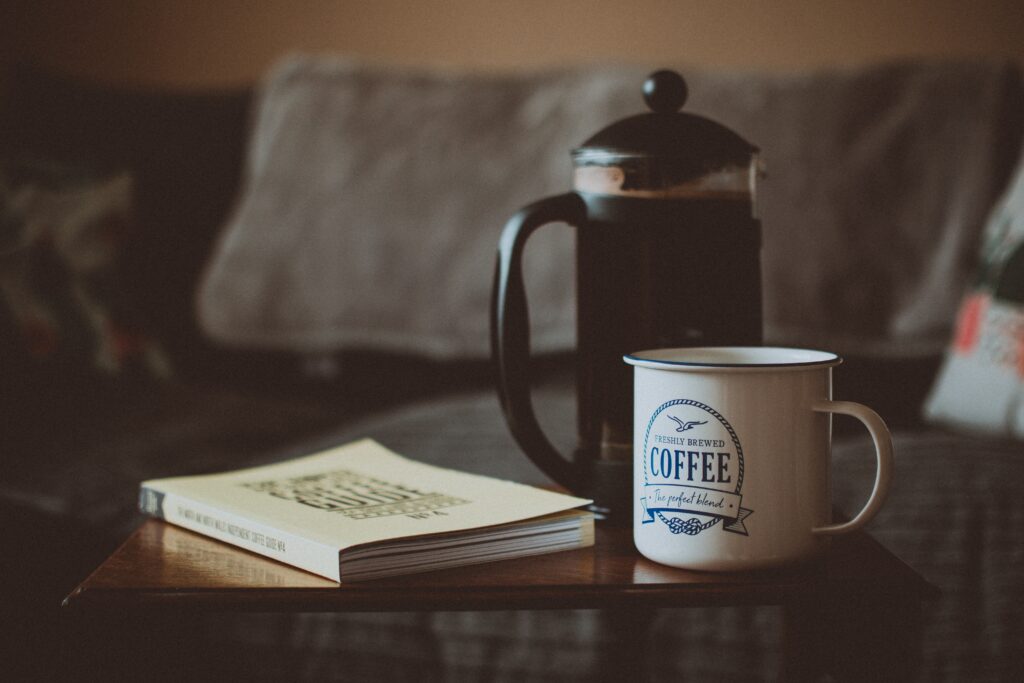
If you don’t pour immediately, you’ll absolutely get over-extracted, bitter coffee. Also, since there’s no paper filter, your French press coffee will have “fines” in it, which are tiny coffee ground particles that slip through the tiny perforations in the metal mesh filters on your plunger. Those fines will also continue to extract, so you really should pour AND drink your French press coffee right away.
Wrapping Up: Making Better French Press Coffee Using Science
The specifics behind how French press coffee works are pretty complicated, but they boil down to some key facts: decreasing extraction too much leads to pulling too many acids out of your grounds and not enough sugars, oils, and plant fibers; and increasing extraction too much means you’ll get all of the compounds you want from your grounds, but the bitter plant fibers will eventually lead to an overly bitter an unpleasant cup of coffee.
I know my explanation of the science of French press coffee was a bit long-winded, but the good news is that you can now dial in your ideal cup of coffee using your French press. You should have a good idea of how to change up your recipe and grind size to bring a smile to your face every morning.
FAQ
What does French press coffee taste like?
When made correctly, French press coffee is beautifully balanced with a light acidity, a nice natural sweetness, and a robust flavor. Most importantly, French press coffee is unfiltered, so many of the coffee oils and lipids remain even after brewing is completed. These additional compounds that would normally be removed by a paper filter in other brewing methods leave a heavy mouthfeel to your coffee. I find that super enjoyable, but others prefer a clean cup.
What’s the best French press coffee recipe?
In my opinion, the best French press recipe is as follows:
- Grind 56 grams of coffee (or the equivalent for the amount of water you’re using in a 1:15 ratio) and add it to your French press, which should sit on a tared kitchen scale
- When your water reaches 210 degrees, start pouring evenly over the grounds and simultaneously start a timer
- Stop pouring when you hit 840 grams
- Stir at one minute, then cover with your lid without pushing the plunger down
- Press and pour at 4 minutes
- Enjoy immediately
How do you make French press coffee better?
There are a surprising number of variables you can change to make your French press coffee tastier if your recipe isn’t working out.
If your coffee tastes sour, acidic, or salty, you can grind a bit finer, increase the water temperature a bit, or increase the total brew time a bit.
If your coffee tastes overly bitter, you can grind a bit coarser, bring down the water temperature a few degrees, or decrease the total brew time by 10 to 15 seconds.
In both cases, try to change the grind size first, then strike water temperature, and then brew time.
If your coffee tastes too strong or aggressive, reduce the coffee-to-water ratio a bit. If you started at 1:15, try 1:16 or 1:17.
If your coffee tastes too weak but not sour or acidic, try increasing your coffee dose. If you started at 1:15, try 1:14.
How does French press coffee work?
Basically, when you add hot water and coffee grounds to your French press, the interactions on a molecular level cause compounds to get pulled out of the grounds and get suspended in the water. These include acids, caffeine, sugar, lipids and oils, and plant fibers. These all extract at different times and at different rates based on the temperature of the water you pour into your French press and the grind size of your coffee.
When you press the plunger down and pour, you effectively stop the brewing process, hopefully when the above compounds are in ideal ratios to one another.