When I finally caved and bought an at-home espresso machine and an espresso grinder, I felt like I had finally hit the big leagues. The equipment was expensive, so I figured it HAD to turn out well. That wasn’t exactly the case. In fact, even with hundreds of dollars worth of espresso equipment, I still needed to tinker with my grind size to get the final product to taste good, let alone delicious.
In this guide, I’m going to help you dial in your grinding to make the perfect shot — or double shot, or…dare I say, triple shot — every single morning. Let’s start by discussing why the grind size matters SO much when it comes to espresso.
Why Grind Size Makes a BIG Difference for Espresso
The grind size you use is a huge factor no matter what style of coffee you’re brewing, but that is especially the case for espresso. There are two factors at play that you’re changing when you alter your grind size: the extraction and the dose.
How Espresso Grind Size Affects Extraction
The finer you grind, the more surface area of the coffee beans you’re exposing, which means the extraction rate speeds up and the extraction time lengthens.
When you make espresso, you’re forcing hot water through your ground coffee with immense pressure — sometimes as much as 9 bars, the equivalent of around 130 PSI or FOUR TIMES the air pressure inside your car tires.
At that pressure, any change in how tightly your coffee grounds are packed is going to make a huge difference in how quickly the water passes through them. And since the interaction between water and grounds yields that sweet, sweet espresso, changing the extraction time means making big changes in your cup.
The issue with grind size adjustments is that the finer you grind the coffee, the more easily it compacts when you tamp it. The more compact your puck of coffee is, the harder it will be for the water to pass through it, which could extend the extraction time.
The bottom line is this: even slight adjustments to the grind size can have a big impact on your espresso. Not only does a change in grind size mean changes to surface area and extraction rate, but it also changes the brew time and the total extraction simultaneously. This is why fine-tuning your espresso grinding can be a real pain.
Unfortunately, there’s more to the story here…
The finer you grind your espresso, the more tightly the grounds compact together when you tamp them, and the more pressure you need to force the water through the coffee puck. The issue with creating more and more pressure inside your portafilter is that eventually, the puck will break under the pressure, and water will travel through the fissures or channels where there is less resistance than in the solid puck.
Water traveling through channels in the espresso interacts with the coffee for less time, which means less extraction, which means off flavors in your espresso. You might think that would lead to under-extraction because the water is in contact with the grounds for less time. Close!
In those areas, you’ll eventually get OVER-extraction because possibly the majority of the water is passing through a single portion of the puck. The heavier water flow will continuously pull compounds out of those grounds in particular, leading to over-extraction.
Okay, that’s it for extraction, but grind size also affects dosing.

How Espresso Grind Size Affects Dose
The second reason your grind size affects your espresso is that it can change your dose of coffee, and by dose, I mean the mass of coffee grounds you use to pull the shot.
Every grinder has what is called grind retention, which refers to the small amount of coffee grounds that get stuck in the grinder, usually due to static electricity. Yes…even zero-retention coffee grinders have grind retention; they just have less than other grinders.
The problem with grind retention is that you weigh your coffee beans oh-so-carefully before you grind, and then you can lose up to a full gram — sometimes even more — of grounds inside your grinder. If you’ve ever tinkered with dose size in espresso, then you know how significant of a difference a gram can make.
Not only that, but the grind retention won’t be the same every time, which means you’ll have a different dose for every shot. AND changing the grind size can also change how much grind retention you get because smaller pieces of coffee beans are more likely to get held up by static electricity. Yikes.
So…how do you fix these issues and get the perfect grind for the perfect shot of espresso? I’m glad you asked.
How to Grind Coffee for the Perfect Espresso Shot
Okay, now we get into the nitty gritty: how do you use your newfound knowledge about how the grind affects the shot to make better espresso? There are a few things you can do.
Step 1: Get a Baseline Grind Size
Your first order of business, especially if you’re new to espresso or have a new espresso grinder, should be to get a baseline grind size. By that, I mean a grind size that gets you close to an ideal flow rate.
Now…this is already going to get complicated because your numbers will vary depending on what you’re used to brewing, but let’s start out with a simple espresso recipe. Let’s assume you start out with 20 grams of coffee and are looking for a yield of 40 grams of brewed espresso.
As you may already know, the target time to pull a single shot of espresso is between 25 and 30 seconds — most aim for around 30 seconds.
So, with that information, you can pick a grind size on your grinder arbitrarily, or you can look up what setting others have used for their espresso. Grind some coffee beans until you have 20 grams of finely-ground coffee. Load up your machine, begin pulling the shot, and start the timer simultaneously. I always recommend using a scale under your espresso cup so that you can see in real time where your yield is.
The goal is to get to 40 grams of espresso at around the 30-second mark. If you find that you get there way earlier, make your grind finer. If you get there much later, make your grind coarser.
Continue this process until you hit 30 seconds. That’s your baseline grind size.
A quick note on espresso machines that use a pump: I recommend counting every two seconds of the “dwell time” as one second of total shot time. Dwell time is the time between when you turn on the water pump and the time you see the first bit of brewed coffee come out of your portafilter. Water pumps cause a delay in brewing, so discounting the dwell time will give you a better sense of total shot time as compared to a high-end machine.
Step 2: Taste Your Coffee and Adapt Your Method
The next step in dialing in the ideal grind setting is NOT TO TOUCH YOUR GRIND SETTING.
As I said before, changing the grind setting by just one tick can lead to big changes in your finished product. Big changes that don’t seem to be controllable can lead to frustration and smashed espresso machines, and no one wants that. Plus, changing your grind size means you now need to clean your grinder thoroughly to get the grind retention at that grind size out before you can start over. It’s just easier not to touch your grind setting.
In my opinion, if you taste the espresso you get after step one and like it, it’s better to tweak it — if necessary — by changing the dose size slightly or by changing how much brewed espresso you get from the shot — the yield.
With that being said, you can and should use grind setting changes to make big alterations to your espresso. Maybe the 20-40-30 method (coffee-water-time) mentioned above leaves you with overly bitter coffee. If that’s the case, grind finder. If your espresso tastes sour, grind coarser. But once you get a good-but-not-great shot, I suggest leaving your grind setting and adjusting elsewhere.
Step 3: Use Dose, Yield, and Puck Prep to Make Finer Adjustments
Once you’ve got the big adjustments made, you can safely leave your grinder setting where it is forever and ever and only ever use other variables to improve your espresso. I’m just kidding, of course. If you find that bigger adjustments are needed — like if you buy a new type of coffee or a different roast — or you just feel like tinkering with the grind setting, go ahead.
But to go from a good shot to a great shot of espresso, I suggest changing dose, yield, and puck prep rather than your grind setting.
Changing Dose to Suit Your Taste
The dose is an easy thing to change, so I recommend starting here. Remember, the dose is just the weight of coffee grounds you load into your portafilter — NOT the weight you load into your grinder because of grind retention!
If your coffee is bland, try increasing the dose. The likelihood is that sugars in the coffee are covering up the other compounds and leading to a flat taste. You can also make your grind a tiny bit coarser as well, although I suggest just increasing the dose.
If the coffee is really in your face, you should try decreasing the dose a bit. In this case, the opposite is occurring — the other compounds are covering up the sugars that should be giving your espresso depth of flavor.
Changing Yield to Suit Your Taste
The yield is how much brewed espresso you end up with in your espresso mug. Generally speaking, this is not an ideal metric to change, but you can use it for super-fine tuning.
If your espresso tastes a tiny bit too acidic, you can push for a slightly higher yield. This means more extraction, which should add a bit of bitterness to balance the acidity.
The opposite is also true. If your espresso tastes slightly too bitter, you can bump down the yield a bit to get less extraction. This will decrease how much of those bitter compounds are being pulled out of the ground coffee.
Changing Puck Prep to Improve Your Espresso
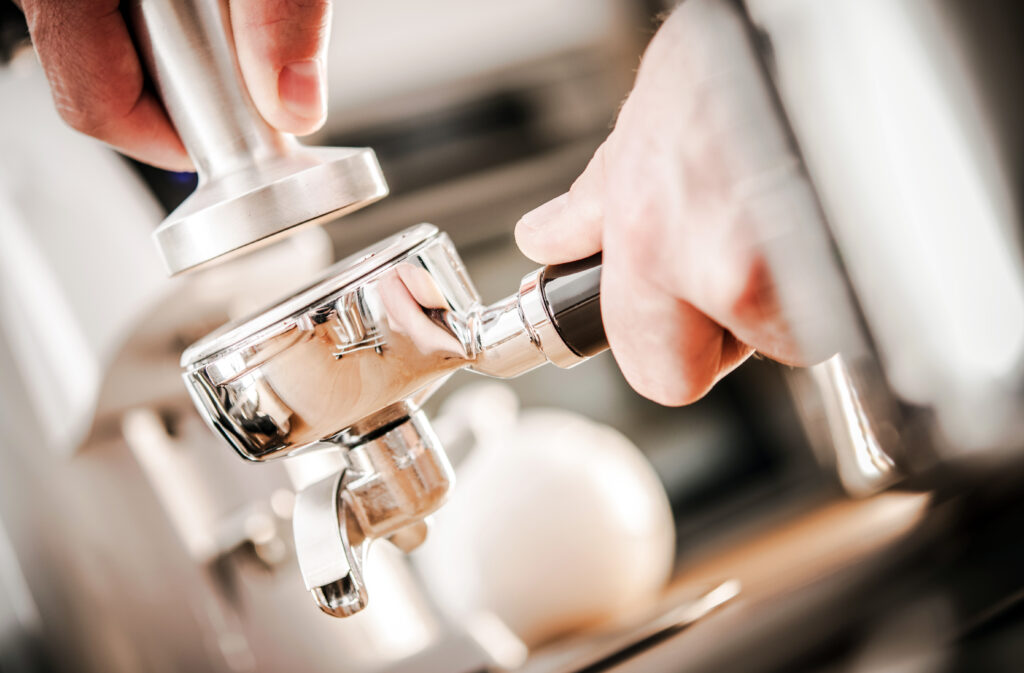
Finally, you can step up your puck prep game to make better espresso that suits your taste. There’s a lot to think about when it comes to prepping the coffee in your portafilter.
First, you should consider grind size distribution in your puck. Every coffee grinder will have some variation in the grind size it spits out in a single batch. Ideally, the puck will be made up of a perfect distribution of those grind sizes. If you have a spot where finer grounds have settled, they will compact more during tamping, prevent coffee from flowing through them, and lead to uneven extraction.
You can fix your distribution by investing in an espresso rake. You don’t need an expensive one, and you can even make your own if you’re into DIYing. Anything to move the grounds around, break up clumps, and distribute the grind sizes evenly will do.
Second, you should consider the density of the puck. By this, I mostly mean how compact each portion of the puck is. When you grind fine espresso that tends to stick together, you’ll naturally get some clumps that can cause dense spots in your puck. I recommend raking these out or shaking the grounds to disassemble those clumps before tamping to keep the density even throughout.
Next, consider fixing the flatness of the puck. When you grind or pour grounds into a portafilter, you’ll be left with a mound in the middle. If you just dive in and tamp the mound down, you’ll get high compaction in the center and low compaction around the sides. Guess what that leads to? Uneven extraction, which will yield unpredictable and off-flavors in your shot. An espresso rake helps flatten out your puck before tamping as well.
Finally, you should do your best to avoid channels in your espresso puck. Channels are areas where water flows through rapidly because of reduced resistance. Channels can form for many reasons, including uneven density, uneven puck thickness, and more. You can avoid channels by raking your espresso, flattening the puck, and tamping with good, even pressure.
Wrapping Up: Achieving The Perfect Espresso Grind
Whew, that was a lot! Hopefully, by now, you realize that dialing in grind size is a massive part of making delicious espresso and that making changes to the grind size is really best for making big changes to your cup. I recommend using the above espresso grinding tips and tricks to get a baseline grind size and then using other variables — like puck prep, dose size, and yield — to tinker a bit and turn that good espresso into great espresso.
FAQ
What’s the best grinder for espresso?
This is a really hard question to answer because every grinder brings something different to the table. Also, good, reliable espresso grinders are going to be quite expensive.
If you’re looking for a manual grinder, I’d recommend the Lido OG, which is also the most affordable one I’d recommend by far. If price is no issue, I’d say go for the Weber EG-1 or the Monolith Flat Max. For something in the middle in terms of price, I’d suggest the Lagom P-64.
What’s the best coffee-to-water ratio for espresso?
Another tough question! Everyone’s taste is different, so you should really do some experimenting and figure out what ratios work best for you. With that being said, I recommend starting with a 1:2 ratio of coffee grounds to brewed espresso that finishes off in around a 30-second pull.
What’s the best espresso machine?
Ugh, this is an all-but-impossible question to answer. If you’re looking for a really good electric espresso machine, I recommend the Profitec Pro 500. If you’re looking for an affordable espresso machine, I wouldn’t recommend anything cheaper than $300 to $400, unfortunately. In that price range, the Breville Bambino is a solid choice. I would also recommend the Flair 58 Manual Espresso Maker, which is a beautiful piece of equipment that makes some darn good espresso.